
Four questions across manufacturing operations
An operations lead asks about safety stock, early signs of equipment failure, next-quarter sales and customers whose contribution has fallen. Inventory, equipment and customer relationships live in separate systems. The questions are connected in the business, but the active data source cannot answer all of them.
The original recording makes the distinction visible. Where the current database contains the relevant records, the product analyzes them. Where a question needs live equipment data or another business system, it identifies what is missing and where to look next. The subsequent customer segments and retention recommendations draw on the CRM records that were available.
“Which materials are below safety stock?” Identify the source first
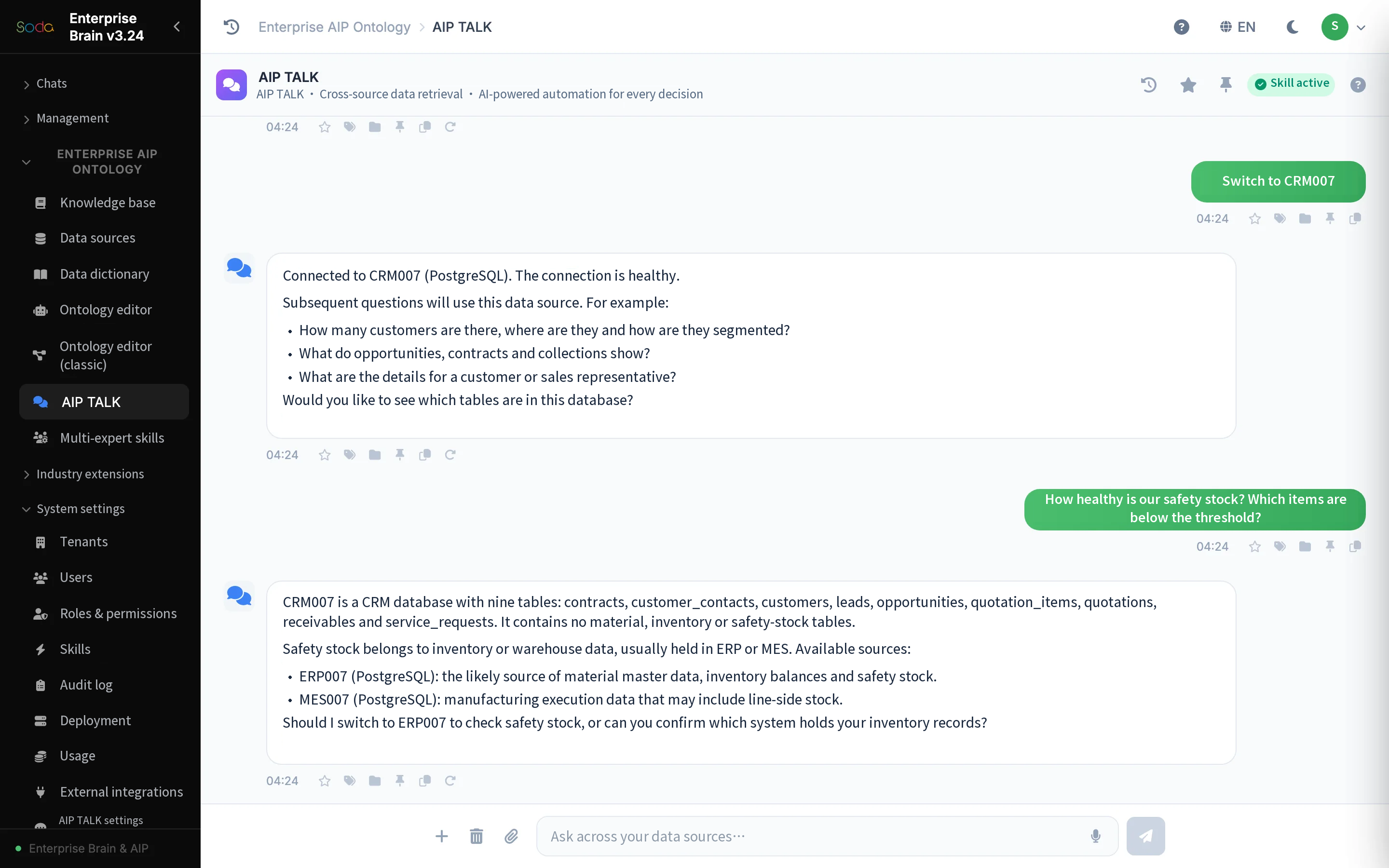
The conversation had switched to CRM007. The product lists 9 tables covering customers, contracts, opportunities, quotations, receivables and service requests, among other records. It then explains that none contains materials, inventory balances or safety-stock levels. The CRM cannot establish which materials are below the threshold.
The answer points to ERP007 as a possible source for material master data, balances and safety-stock records. It also notes that MES007 may hold line-side inventory. This exchange establishes the boundary and suggests the next query. It does not return a cross-database inventory result.
“Which machines show signs of failure?” Separate technical guidance from live status
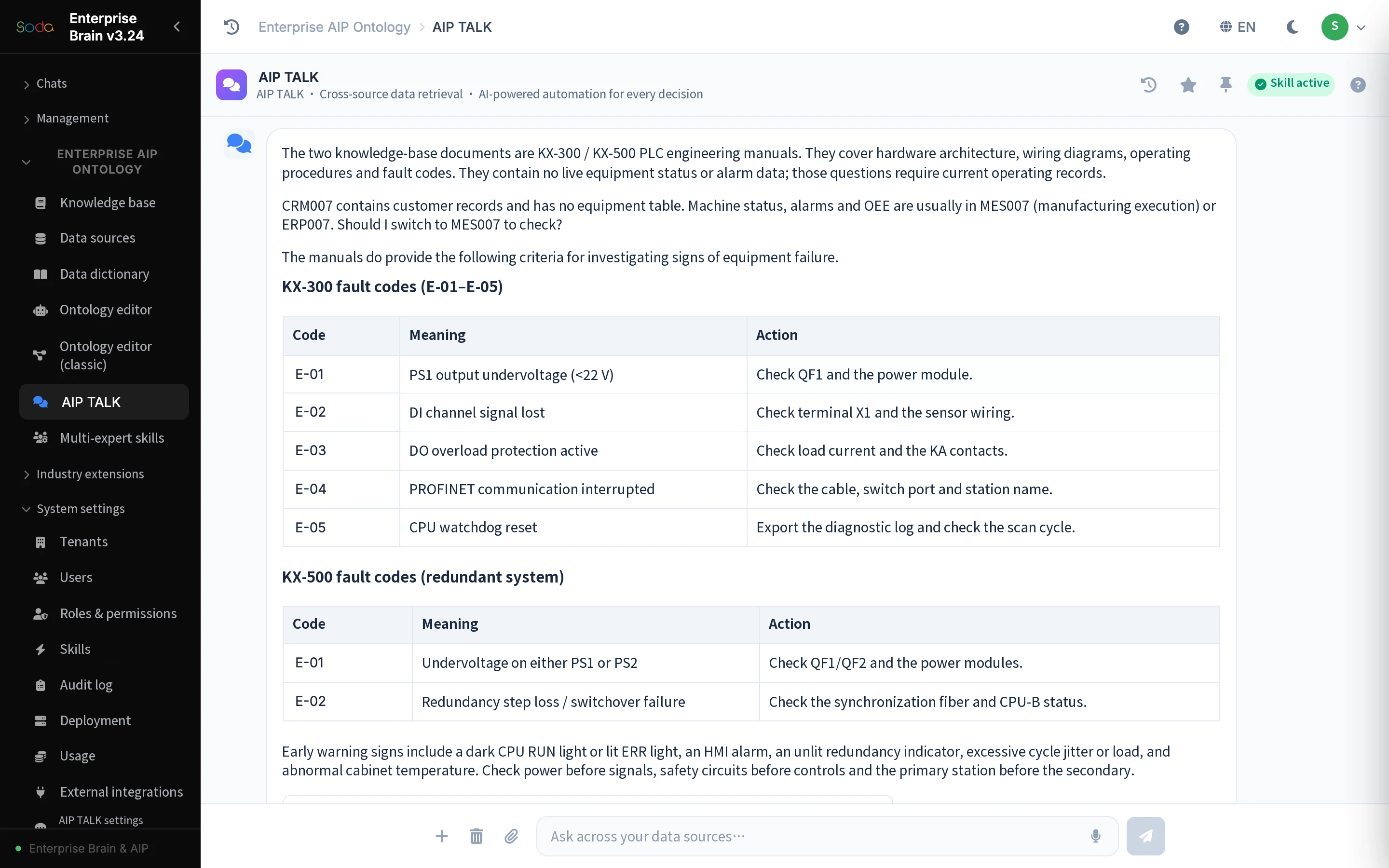
The second question turns to equipment. Retrieval finds engineering notes for KX-300 and KX-500 PLCs, covering hardware architecture, wiring diagrams, operating procedures and fault codes. The documents do not report the current operating state, and CRM007 has no equipment table. Live status, alarms and overall equipment effectiveness (OEE) require MES or related machine data.
Within the available material, the product explains the fault codes and points to the corresponding checks in the manual. This helps field staff locate diagnostic criteria while keeping a manual’s explanation of a fault distinct from evidence that a particular machine has developed one.
“Forecast sales next quarter.” Compare signed contracts with quotation activity
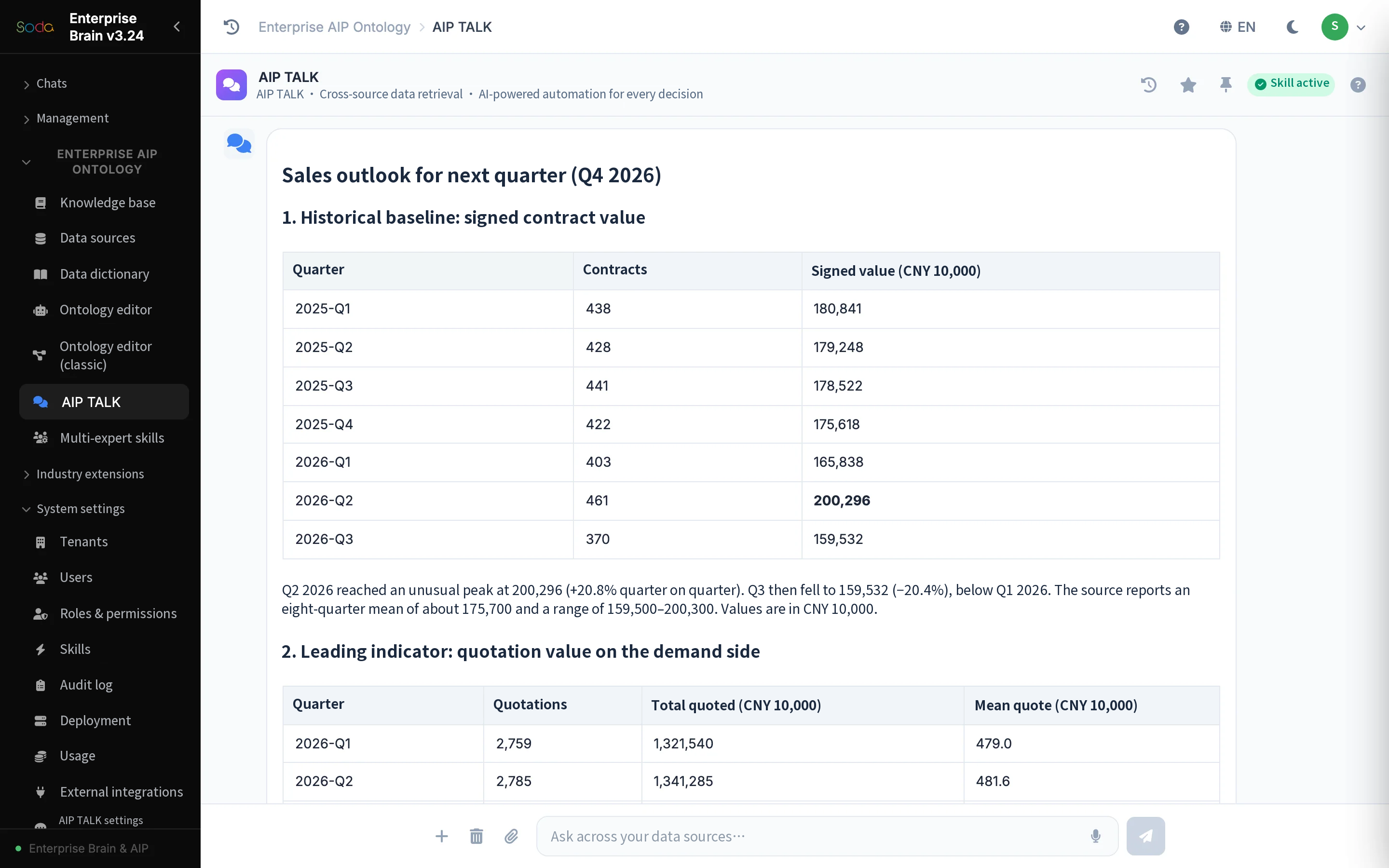
The third exchange concerns Q4 2026. The product groups historical signed contract value by quarter, identifying an unusually high point in Q2 2026 and a subsequent fall in Q3. The recorded quarter-on-quarter changes are +20.8% and −20.4%, respectively. Any forecast needs to account for that volatility.
The answer then considers total quoted value, quotation count and average quotation value as early demand signals, separately from signed contracts. This records the forecasting method used at the time. Quotes still need to convert, and the outlook should change as new opportunity, contract and delivery information comes in. It is not a realized sales figure.
“Which customers are contributing less?” Examine the comparison periods and risk signals
The analysis compares two six-month windows, Q4 2025 through Q1 2026 and Q2 through Q3 2026. Total signed contract value fell for 25 customers. Of those, 19 signed no contracts in the later window. These were custom comparison periods rather than the first and second halves of a calendar year.
The product then groups the customers by severity. The highest-priority group includes 8 customers who previously contributed substantial contract value and signed nothing in the second window. For each group, the analysis examines open opportunities, quotation conversion, delivery feedback and complaints. Some customers placed fewer orders after expressing dissatisfaction with delivery. Others had only a few negotiations or sample requests left, or outstanding quotes that had not converted. The public account retains the risk patterns and aggregate counts while omitting customer-level records and sales representatives’ names.
Turn a decline in bookings into specific follow-up questions
The original exchange proposes follow-up by risk group. Check delivery issues and complaints among high-contribution customers first, then review unconverted quotations and opportunity progress. Prioritize outreach by the severity of the signals. This gives the business team specific explanations to test for each decline.
The answer also explicitly discards an unrelated recruiting case collection returned by the knowledge search and ties its customer analysis to the active CRM007 dataset. The record demonstrates source selection, contribution-based segmentation and suggested follow-up. Actual contract records would be needed to establish whether customers ordered again. The extended manufacturing demonstration covers production quality, supply chains and equipment knowledge with separate synthetic data. Its figures are excluded from this case.